

When Projects Fail Not Because of Technology – But Because of People
Does this sound familiar?
You are assigned to lead an important project. Motivated and enthusiastic, you begin assembling a strong team. Yet even at this early stage, the first challenges appear.
Two potential team members have had ongoing conflicts for some time – forcing you to choose between them. Another expert you would like to include in the project is not released by their supervisor. Instead, you are assigned a replacement, although you already know that collaboration with other team members may be difficult.
And the list could go on.
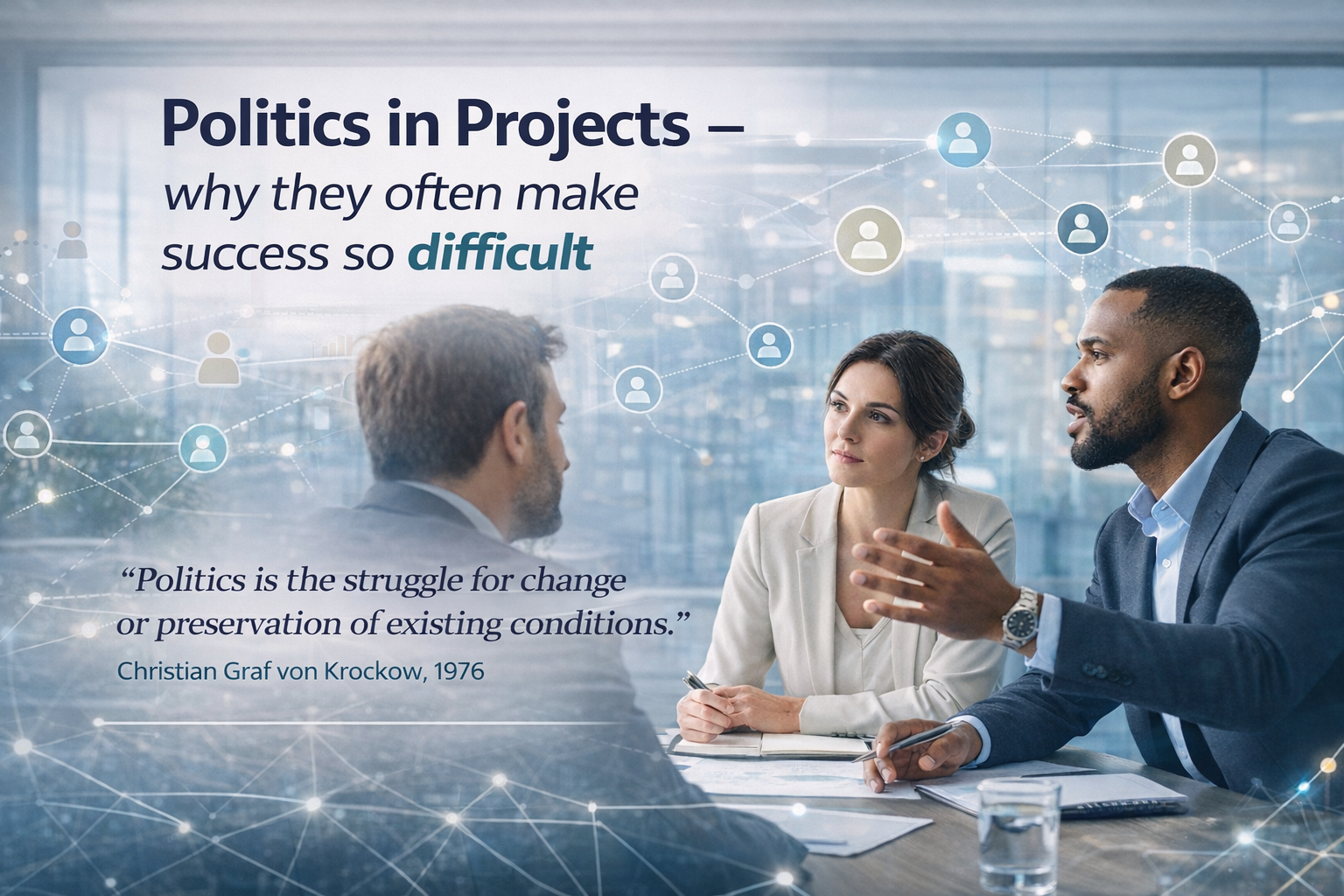
Many of the challenges that complicate projects do not arise from technical or professional issues, but rather from interpersonal dynamics, conflicting interests, and communication problems.
In short: project politics.
The Underestimated Dimension of Projects
Most project challenges are not surprising. In fact, many of them are predictable and therefore manageable.
At the same time, successful projects rarely happen by chance. They can be planned and shaped if the focus is placed on the right factors.
One of the most important factors is the composition of high-performing teams. Productive and efficient teams do not simply emerge automatically. Different personalities, working styles, and communication patterns come together and must function effectively as a unit.
As our working environments become increasingly complex, this challenge continues to grow. People often find themselves in situations where they are unsure how to react or how to behave within new or changing circumstances.
Anyone who fails to adapt their own behavior – and that of their team – to the requirements of their working environment will eventually struggle to lead successfully and manage projects effectively.
But how can we better understand ourselves and the people around us?
Understanding Behavior – The Key to Better Collaboration
One effective approach is to systematically reflect on our own behavior and gain a better understanding of how others act and communicate.
This is where behavioral assessments come into play.
One particularly proven method is the DISC model, known for its pragmatic and practical approach.
DiSC is an acronym representing four primary behavioral styles:
- D – Dominance
- I – Influence
- S – Steadiness
- C – Conscientiousness
The model helps make different communication and working styles visible and easier to understand. Its focus lies on practical application: How do people communicate? How do they make decisions? How do they react to pressure, change, or conflict?
The goal is not to categorize or judge people. Instead, the model helps individuals:
- better understand themselves
- better understand others
- adapt their behavior appropriately to different situations
Why Communication Determines Project Success
Inefficient communication and unresolved conflicts do not only cost time in projects – they also cost money.
Misunderstandings lead to delays, decisions are postponed or revised, opportunities remain unused, and team motivation often declines when collaboration becomes difficult.
For this reason, it is essential to build teams not only based on technical expertise, but also by considering the dynamics between the people involved.
A Proven Tool: The Ensize DISC Assessment
At Conmetis AG, we use the Ensize DISC assessment as part of our work.
Ensize International was founded in Sweden in 1992 and has since become a global assessment company specializing in leadership, organizational development, sales, and human behavior. Their instruments are based on established behavioral research and are delivered through a modern online platform that provides training, knowledge resources, and assessments.
The method has proven itself in practice for more than 25 years. It is quick to implement, easy to understand, and flexible enough to be used in a variety of contexts.
For example in:
- recruitment of new employees
- project team composition
- team development
- conflict management
- leadership development
One major advantage is that the assessment is practical, easy to understand, and non-judgmental. It creates transparency around different communication and working styles and significantly improves collaboration.
Unlocking More Potential in People and Projects
Organizations that understand the dynamics of behavior and communication can develop stronger teams and manage projects more successfully.
Ultimately, project success depends not only on technical excellence but also on the quality of collaboration.
If you are interested in strengthening the potential of your teams and improving collaboration within your projects, we would be pleased to hear from you.